
Congestion Pricing in New York City: Everybody’s Winning
Jan 18, 2026
The New York Times yesterday published a deep-dive review of multiple data sets from New York City, NY State and the Metropolitan Transit Authority to assess the effects of the city’s congestion pricing program one year into its implementation.
And guess what? On every metric, it is achieving its goals – dramatically so. Fewer cars are driving into Midtown and Lower Manhattan; trip times have improved; transit use is up; vehicular injuries are down; traveler patterns are adjusting; pollution is reduced. Best of all, people are very happy about it – even a large share of the driving public that is paying the toll.

Here’s a summary of key findings from The Times analysis:
Fewer vehicles: About 27 million vehicles – better than one in nine – disappeared from the streets of the Congestion Reduction Zone (defined as south of 60th Street) last year. This amounts to about 73,000 cars and trucks daily, and that number stood up throughout the year.
Faster trip times: Vehicles moved 4.5 percent faster in the congestion zone than the previous year. Those faster speeds diminished somewhat throughout the year, but the margin of improvement compared to 2024 stuck month-to-month, suggesting the slower speeds were seasonally influenced.
Perhaps the most remarkable findings regarding trip times were recorded outside the congestion zone, including:
· At the near-periphery of the CRZ cordon, where many doomsayers had predicted an avalanche of cars converging to get as close in as possible without paying, speeds improved 2.2 percent.
· Throughout the rest of the city speeds also improved – by 1.4 percent – though whether and how much of this change is attributable to the pricing program was not part of The Times report.
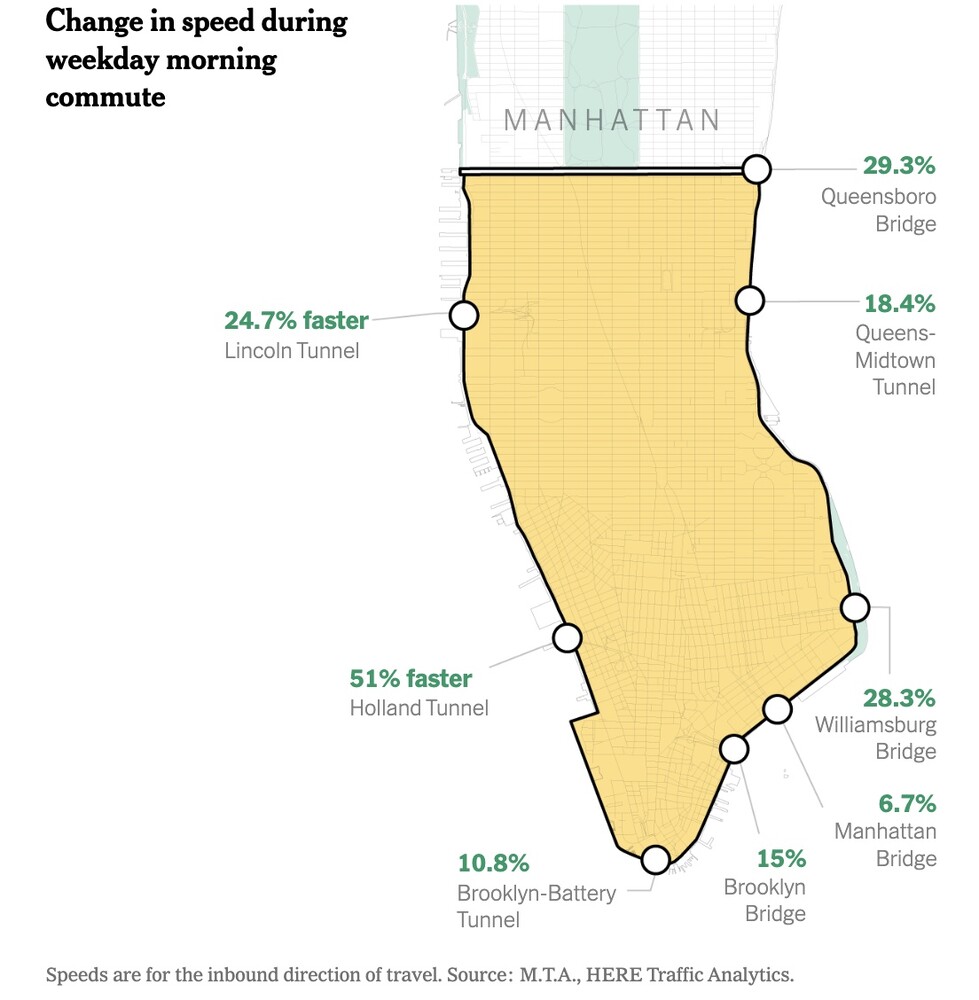
· Extraordinary improvements were recorded at every single gateway crossing into Midtown and Lower Manhattan: 51 percent at the Holland Tunnel; 29 percent at the Queensboro Bridge; 28 percent at the Williamsburg; 25 percent at the Lincoln; and 18 percent at the Queens-Midtown Tunnel.
· Bus speeds have improved too – as much as 2.4 percent in the CBD – accomplishing one of Mayor Mamdani’s major policy goals even before he set foot in the office
Transit ridership is growing across the system. Subways saw a growth of 300,000 riders last year. Similarly, ridership is also up on the commuter rail links. “Congestion pricing has not dampened activity in the busiest parts of the city, as critics feared,” The Times report explains. “People are still coming, just not necessarily by private car.”
Moreover, the program will raise $550 million for the MTA to invest in transit improvements throughout its system, ten percent more than initially projected. As NYS DOT Commissioner Marie Theresa Dominguez proudly declared at a recent event in Philadelphia that I attended: “For the first time in anyone’s memory, New York City’s transit system is fully funded.” And these system investments will only make transit a better, more attractive option than driving downtown – reinforcing the program’s broad-based benefits.
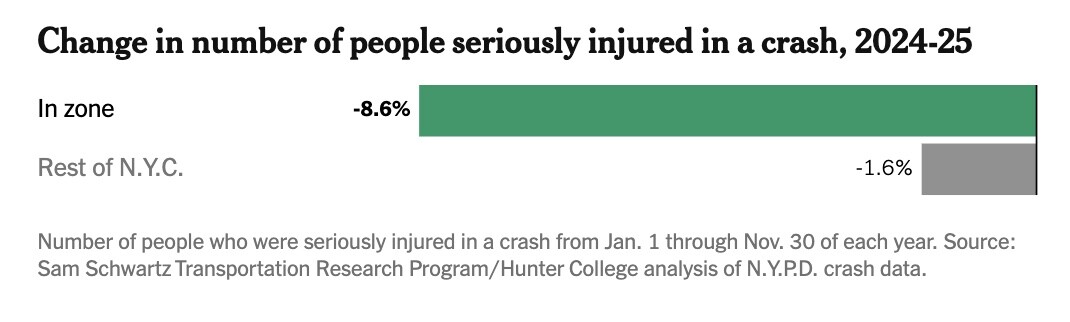
Streets are safer. Possibly the best news of all: an 8.6 percent drop in serious injuries from crashes in the CBD and a 1.6 percent reduction in the remainder of the City. Says Brooklyn resident Charlie Rokonsky, “Fewer cars honking, fewer cars running red lights, fewer cars blocking crosswalks.”
Pollution curtailments. The number of vehicular noise calls to New York’s 311 complaint line is 17 percent less than in 2024. And air quality (which affects the entire region and beyond) has also shown improvement, as documented by a Cornell University study finding of 22 percent less fine particulate matter in the congestion zone after the first six months of the program.
Public approval: Nobody likes tolls, it is often said. Except now, maybe New Yorkers do. The Times report did not measure public opinion, but cited a rich sampling of testimonials from people who are experiencing the benefits first-hand, even from the very drivers who are paying the fee. Here’s a few:
· “Traffic approaching the [Holland] tunnel has saved me 15-30 minutes on the rides back to New York and given me hours of my time back.” - Salvatore Franchino, Brooklyn
· “It turns out that mostly when people say ‘New York is noisy’ they really mean ‘cars are noisy.’” - Grant Louis, Manhattan
· “Even across the river in Bergen County, I feel that we benefit.” - Michelle Carvell, Englewood Cliffs, N.J.
· “I am thrilled that we have not seen negative impacts to local business.” - Tom Harris, President, Times Square Alliance
· “As an asthmatic, I can palpably feel improvements in the air quality.” - Rob Hult Brooklyn
New York City’s success should encourage large cities across the US – almost all of them struggling with the issues of safe, sustainable and efficient mobility while their transit systems are without exception facing dire fiscal collapse – to consider implementing pricing solutions in their central business districts.

Of course, New York’s program still faces a wrong-headed and vindictive attack from the Trump administration, but the data are accumulating and undeniable in their conclusion: congestion pricing is an unequivocal public benefit and its reversal (heaven forbid!) would only be effected at the cost of enormous damage to all.
Written by Roger J. Cohen, Senior Policy Advisor, Rensel Consulting